Commercial Waste Removal in Putney

Commercial waste removal in Putney needs to be straightforward, tidy and suited to the rhythm of a working day. We collect and remove business waste from premises of many types, helping organisations clear unwanted material without turning routine operations upside down. The service covers general commercial rubbish, mixed office waste, bulky items and other non-hazardous materials that need careful handling, sensible sorting and responsible disposal.
For many businesses, the main benefit is having a clear plan for waste that has built up after refits, stock changes, equipment replacements or busy trading periods. We focus on practical clearance work that reduces clutter, supports safe circulation and leaves spaces ready for their next use. Our aim is simple: make the removal process organised, transparent and suited to the site rather than forcing the site to fit the waste.
If you need a quotation, start with a brief description of what is to be removed and where it is located. A few details about access, floor level and the type of waste help shape a more accurate response. Request a quote once you have the basics ready and we can guide the next step. For general enquiries, you can also explore our pricing and quotes information.
Business waste collections for everyday operations
Business premises generate waste in different ways, from packaging and storage leftovers to worn-out fixtures and mixed rubbish from periodic clear-outs. Our business waste removal service is designed to handle those practical collections without unnecessary disruption. It suits offices, retail units, workshops and other workplaces that need regular help with items that are too awkward, bulky or numerous for standard bins.
We collect material that is ready to leave the site, then arrange it for the appropriate disposal route. That can include separating reusable or recyclable material where it is suitable to do so, as well as dealing with general waste that cannot be kept for normal recycling channels. If your organisation wants a clearer approach to ongoing disposal, it is sensible to plan the removal by type of waste and by access point so the work can be completed efficiently.
When the load contains mixed items, useful information usually includes the approximate volume, whether anything is heavy or awkward, and whether the waste is stored upstairs, in a yard or in a shared service area. Those details help us match the collection to the premises and avoid delay. If you are comparing service options, the business waste removal page sets out a focused route for commercial clients who want a dedicated clearance solution.
Office clearance work and workplace reorganisation
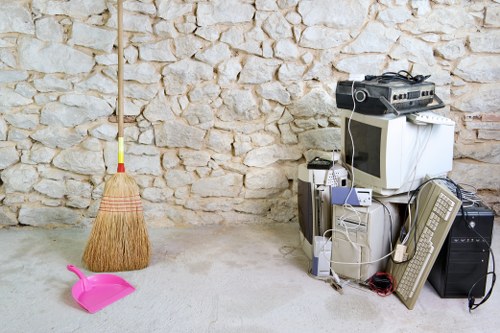
Office clearance is often about more than throwing items away. Desks, chairs, filing cabinets, partitions, cupboards and redundant IT furniture can all become obstacles when a layout changes or a lease comes to an end. We remove office waste and surplus furnishings in a way that supports orderly handovers, refurbishments and day-to-day reorganisations. The emphasis is on sensible handling, particularly where items are heavy, awkward or made from mixed materials.
Offices often need a more structured approach than a simple collection because there may be access restrictions, shared corridors, lifts or building management rules. It helps to identify what stays and what goes before the visit, then separate confidential material, reusable furniture and general office rubbish where practical. We can also deal with paper waste and unwanted workplace items that are no longer suitable for storage or use.
If your clearance includes documents that must be treated carefully, confidential shredding may be relevant. It is also worth thinking about whether certain desks, seating or storage pieces are destined for disposal, donation or relocation. The office clearance page is a useful place to look when you want the work organised around office furniture, fittings and mixed workplace contents.
Bulky item removal and furniture disposal
Many commercial clearances include items that are simple in concept but awkward in practice: reception seating, worn office chairs, damaged storage units, tables, shelving and other furniture that no longer has a place on the premises. Our bulky item removal and furniture disposal work is intended for those pieces that take up space, require two-person handling or need dismantling before they can be taken away safely.
Furniture removal is easier to organise when the access route is clear and the items to be collected are identified in advance. Some pieces can be carried as they are, while others need partial dismantling or separation of components such as glass, metal and upholstery. We manage that kind of practical judgement on site. Clear labelling, clear access and clear priorities make the collection more efficient and help protect the surrounding workspace from avoidable damage.
Where the waste is mainly made up of furnishings, the dedicated furniture clearance page gives a straightforward route to the right service. If individual pieces are the main issue, furniture disposal is another relevant option, especially when you want the removal focused on particular items rather than a wider site clearance.
Shop, storage and general site clearances
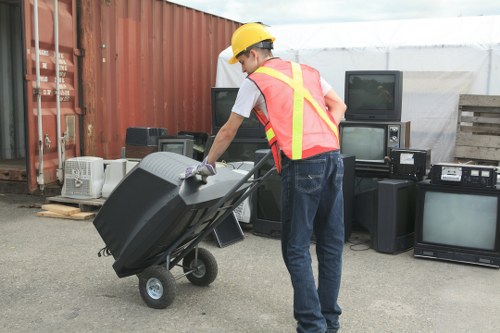
Not every commercial clearance is an office job. Retail stockrooms, front-of-house areas, shared storage rooms and back-of-house spaces can all accumulate broken fixtures, surplus packaging, displays, mixed rubbish and old stock. We carry out general site clearances for businesses that need a tidy, practical removal of items no longer required on the premises. The work is planned around access, volume and the physical character of the waste.
For larger clear-outs, it is often useful to decide whether the work should cover only the visible waste or include adjacent storage spaces, shelves and ancillary items that have also become redundant. That decision can affect how long the clearance takes and how the load is organised. Separating useful stock from waste before the visit is usually sensible, because it reduces the risk of removing items that still have value to the business.
Where a business needs a more general solution for cluttered premises, the waste removal page describes the broader service scope. If the job is tied to a change in occupancy, stock rationalisation or property handover, it may also be worth reviewing home clearance or house clearance only if you are dealing with mixed domestic and commercial contents at the same site; otherwise, business-focused pages will usually be the better fit.
Recycling-led handling and sustainable disposal
Commercial waste removal should not treat every item in the same way. A mixed collection can include cardboard, metals, plastics, wood, fittings and redundant equipment, each of which may need a different route after it leaves the site. Our removal work is arranged with recycling and sustainability in mind, so suitable material can be separated where possible and managed in a more responsible way than simple bulk disposal.
That approach matters when a business wants to keep disposal orderly and avoid unnecessary landfill use for items that have a better recovery option. The exact handling depends on what is being removed, whether it is clean or contaminated, and whether it can be grouped with other recyclable material. In practice, it is useful to think about the waste stream before collection rather than after it has already been mixed together.
For businesses interested in how material is sorted after collection, the recycling and sustainability page provides a helpful overview. If the removal involves clear-up work after building alterations, the builders waste clearance page may also be relevant because construction-related debris usually needs a different handling approach from day-to-day commercial rubbish.
About Putney
Putney is a district in southwest London on the south bank of the River Thames, within the London Borough of Wandsworth. It is widely known for Putney Bridge, which links the area to Fulham, and for its long association with the river, rowing and riverside movement. The Thames Path runs through the area, bringing together stretches of open river frontage, moorings and public access along the embankment. Putney High Street forms a busy local spine with shops, services and transport connections, while the surrounding streets show a mix of historic terraces, interwar developments and later residential blocks. The parish church of St Mary’s has strong historical significance, as it is associated with the Putney Debates of 1647, an important moment in English political history. Beyond the core centre, the area opens into places such as Putney Heath and Wimbledon Common at its northern edge, offering a contrast between urban streets and broad open land. East Putney and West Putney are commonly used as local references, though they sit within the same wider district rather than being separate towns. The riverside setting has helped shape the character of the area, from boathouses and clubs to public walks and views across the water. Putney also has a long transport history, with rail and Underground connections supporting its role as a lived-in, active part of London rather than a purely commuter address. Its combination of river, green space, historic buildings and commercial frontage gives it a varied and distinctive urban form.
Clearance for garages, storage rooms and back areas

Commercial waste often hides in places that are not part of the main customer-facing area. Garages, cellars, sheds, cupboards, store rooms and back-of-house corners can collect broken equipment, redundant packaging, obsolete stock and assorted rubbish over time. Our clearance work for these spaces is intended to recover usable room and remove the material that is no longer needed. That can be useful for maintenance teams, landlords, facilities managers and smaller firms with limited storage.
These areas often contain a mixture of loose and bulky material, so a quick visual estimate is not always enough to plan the work properly. It can help to group items by type before the collection, particularly when the waste includes shelving, tubs, tools, old signage or broken fixtures. If the space is difficult to reach, let us know about stairs, narrow doors or shared access so the removal can be approached sensibly.
For a dedicated look at this kind of work, the garage clearance page is the relevant destination. If the problem extends upwards into rafters or overhead storage, then loft clearance may also be useful, especially where a site holds business records, display items or surplus materials in higher storage spaces.
Special items: appliances, shredding and awkward waste
Some commercial clearances involve items that need more specific treatment than ordinary mixed waste. Fridges, freezers and other appliances may contain materials that must be processed separately, while confidential papers or records may require shredding rather than simple disposal. We also handle certain awkward items that are best removed as a controlled part of the clearance rather than left to accumulate around the site.
It is sensible to identify these items early, because they may affect how the load is arranged and whether additional preparation is needed. For example, appliances should be empty and disconnected before removal, and confidential material should be set aside clearly from ordinary paper waste. Good separation saves time and reduces uncertainty when different waste streams are involved. When in doubt, describing the item plainly is often enough to direct it to the right route.
Where that kind of specialised collection is needed, the fridge and appliance removal page and the confidential shredding page both provide useful next steps. If the load includes broken items with limited reuse value, the mattress and sofa disposal page can also be relevant for bulky household-style items found in mixed premises.
Pricing, access and how to prepare a quotation

The cost of commercial waste removal usually depends on the volume of waste, the type of material, the ease of access and whether any items need separating, dismantling or special handling. A collection from ground level with clear parking and straightforward loading will normally be simpler to organise than a job with restricted access, multiple floors or mixed waste types. We keep the process practical rather than complicated, so the quotation can reflect what is actually there.
Two pieces of preparation are especially helpful when you are seeking a quote: first, a clear description of the waste and where it is stored; second, a brief note on access, timing and any site rules that matter. If photographs are available, they can help with larger or mixed loads, but they are not the only way to explain the job. Accuracy comes from specifics, so a simple inventory is often better than broad wording.
For the final step, you can use the contact us page to request a quotation and discuss the collection. If you prefer to book online, the book online page is also available. Either way, send the main details and we will take it from there.
Commercial waste removal tailored to the job
Different businesses need different types of clearance support, and the most effective approach is usually the one that matches the site rather than forcing the site into a rigid format. Some clients need a one-off clearance after a reorganisation, while others want help with recurring commercial waste that has outgrown their current arrangements. We can keep the work focused on the items that matter most and avoid unnecessary handling where a simpler route will do.
A clear plan is especially useful when the waste is spread across several rooms or when there are several item types to manage at once. In those situations, it helps to think in terms of zones: what stays, what goes, and what needs separate treatment. That is one reason why a short description at the start makes a meaningful difference. If you are ready to move ahead, ask for a quotation and outline the main load in plain terms.
For ongoing business owners and property managers, the right service page can save time as well as effort. The broader about us page explains the company in general terms, while the payment and security page may be useful if you want to understand practical transaction arrangements before proceeding. When you are ready, send the details and request a quotation today.